
A Flaw In Adjustment
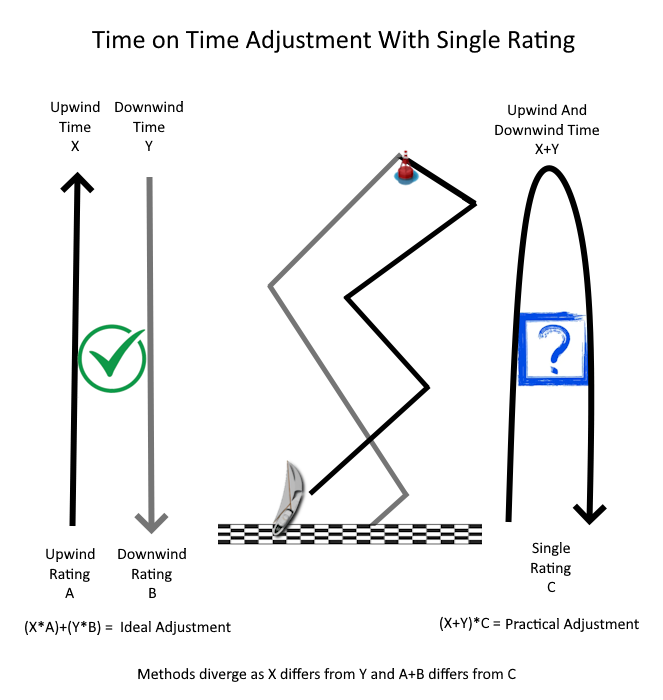
We examine the effect of applying different ORR-EZ course types when scoring a windward leeward course to account for a flaw in adjustment when using Time On Time (TOT) scoring with unknown durations of upwind and downwind sailing. Ideally our handicap would be created by using the upwind rating for the upwind duration and the downwind rating for the downwind duration. However we do not take times at all marks, only the start and finish.
So in practice a boat that takes more time sailing upwind than downwind will have its downwind rating applied to a portion of its upwind sailing, and vice versa. This becomes an issue for boats with faster expected speeds in one direction, resulting in more time owed than expected.
Jump Ahead
Distill The Problem
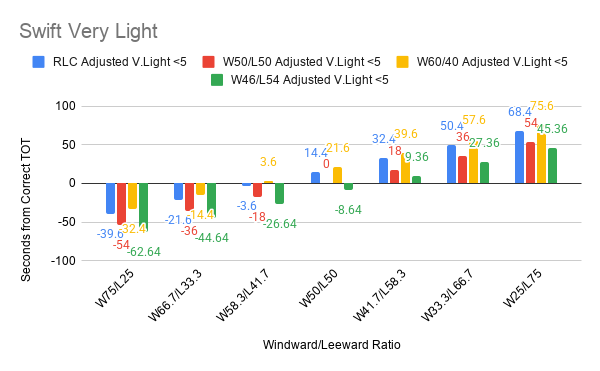
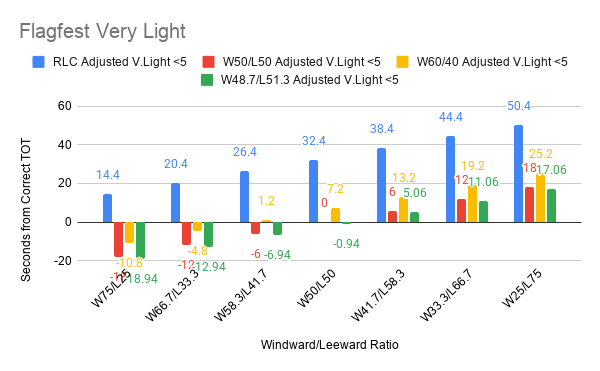
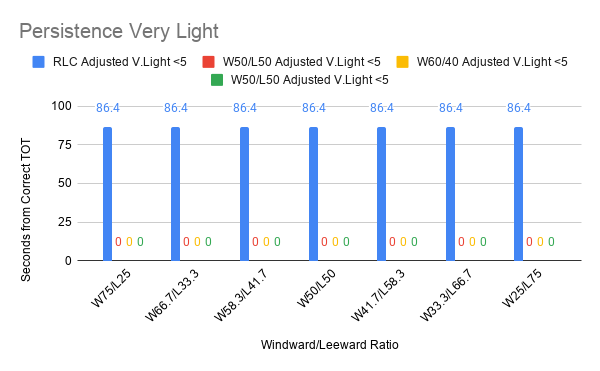
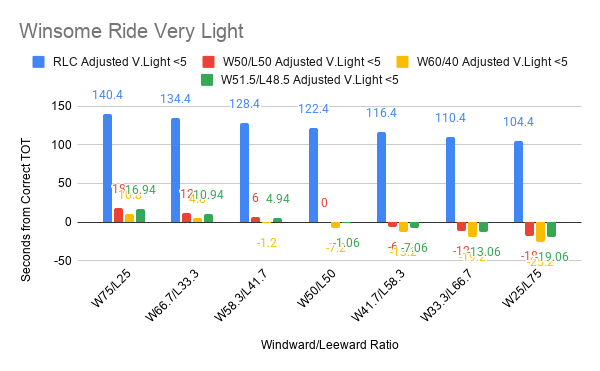
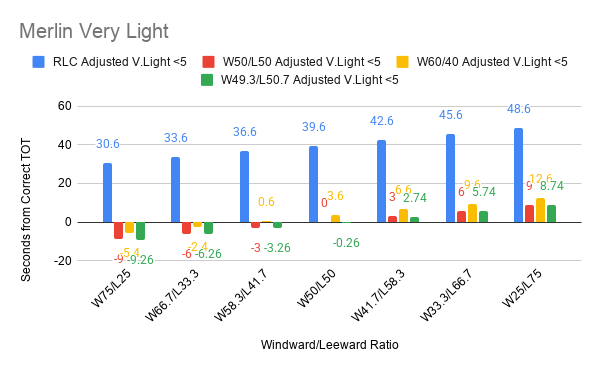
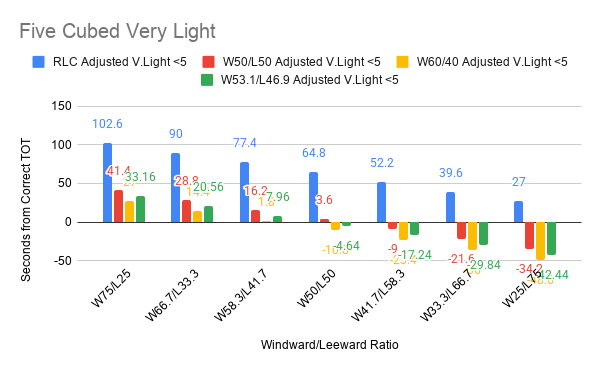
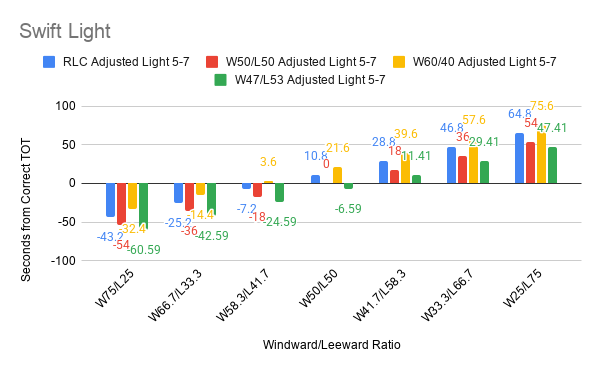
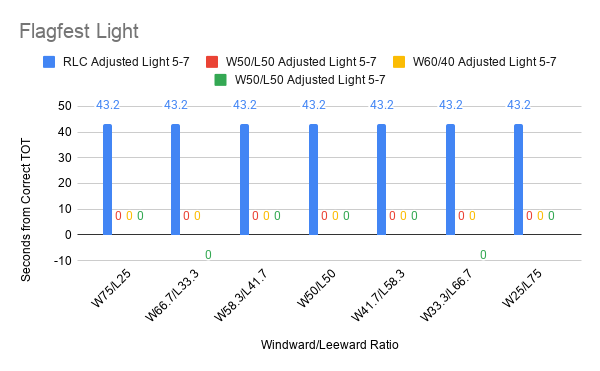
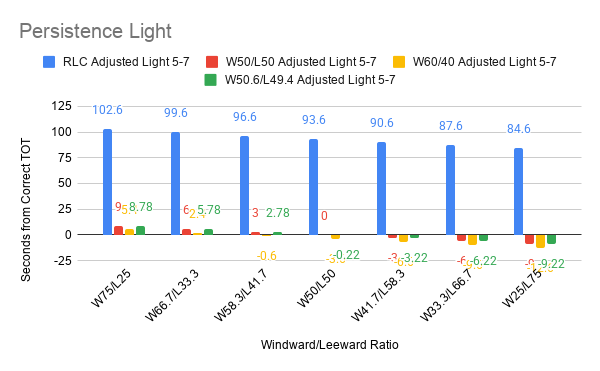
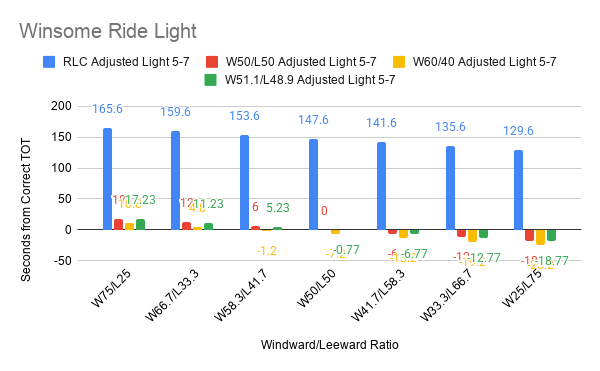
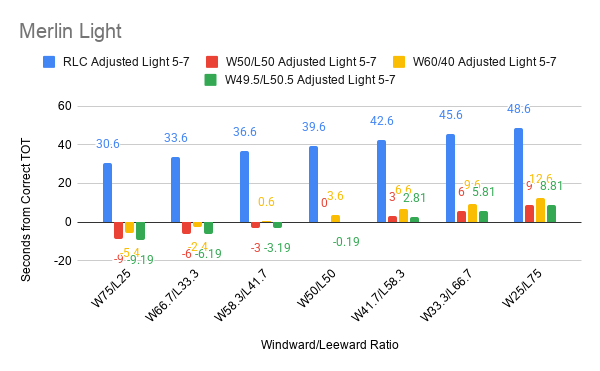
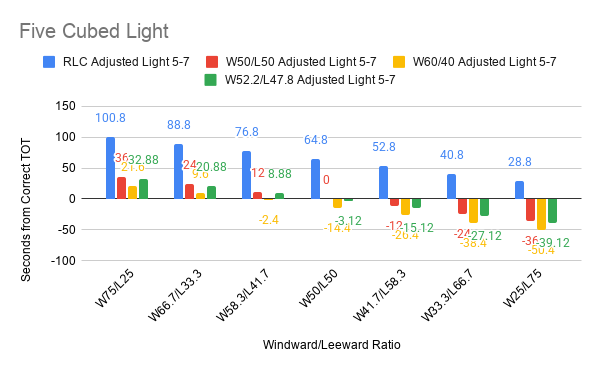
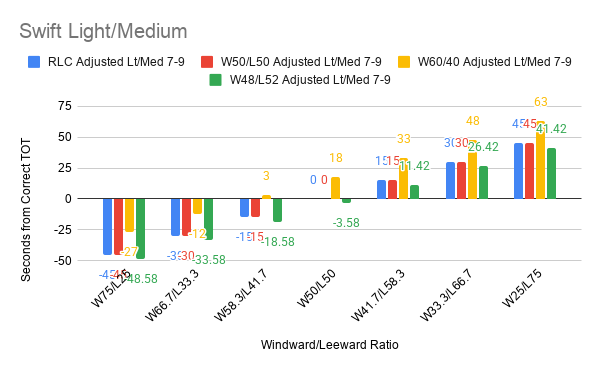
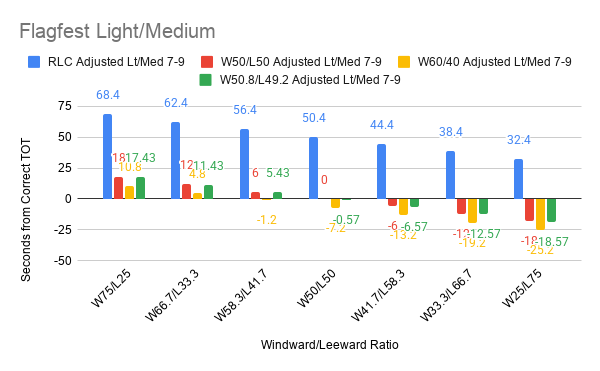
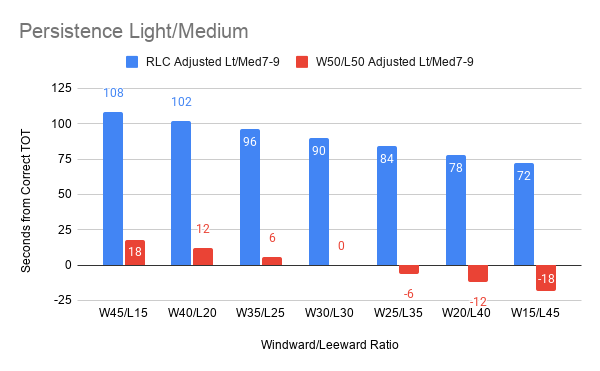
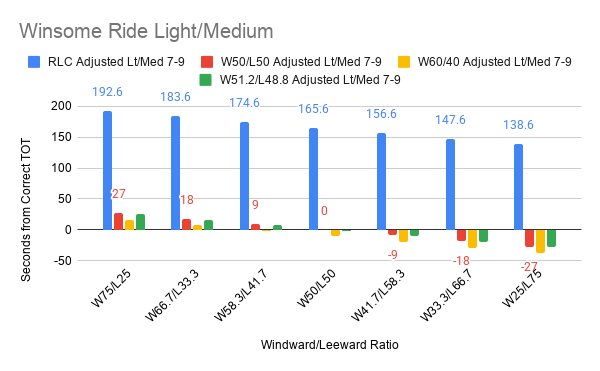
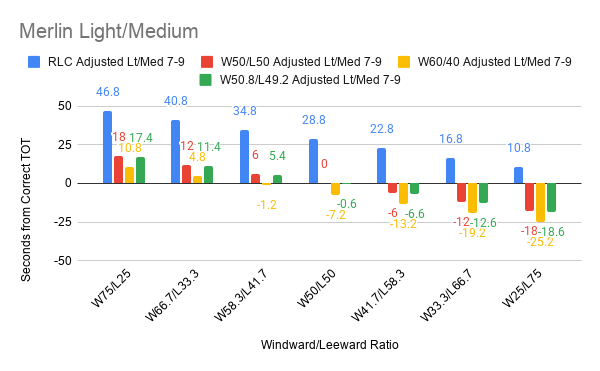
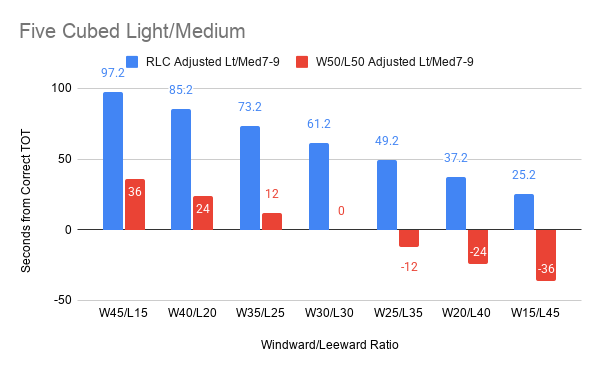
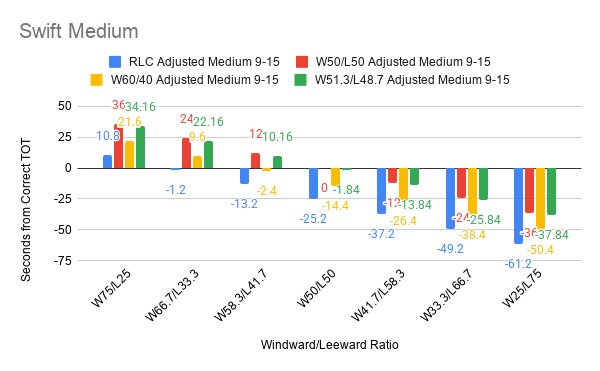
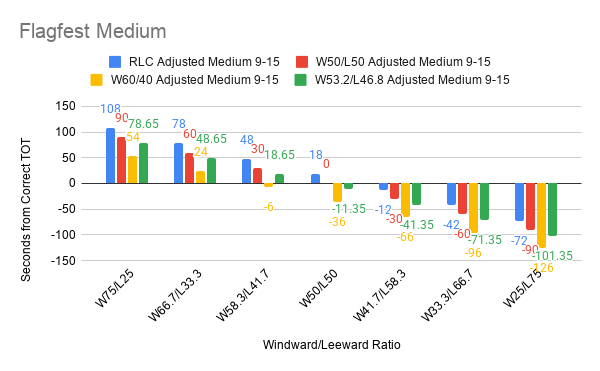
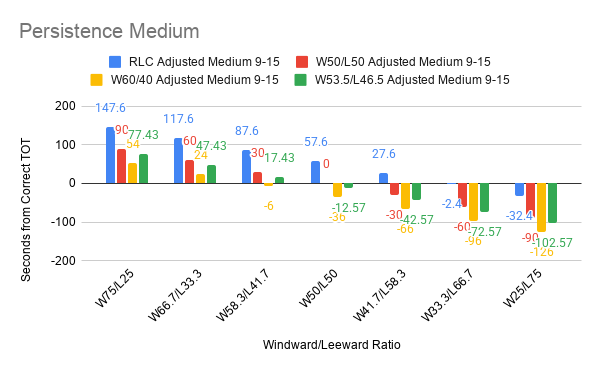
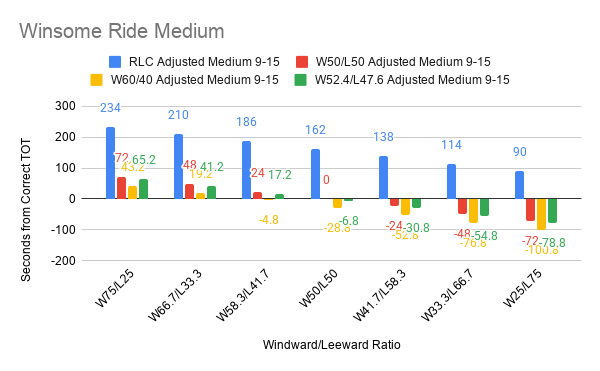
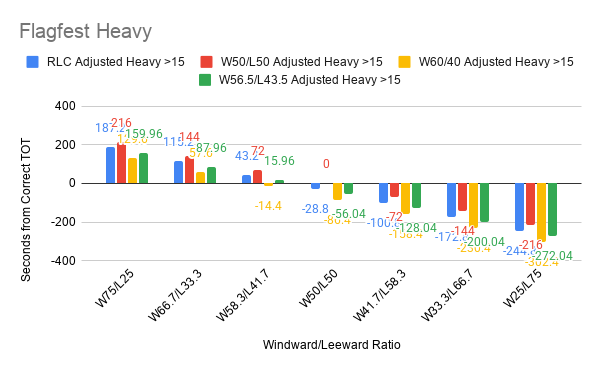
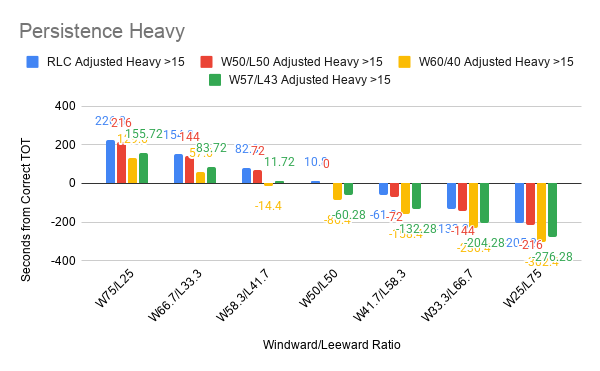
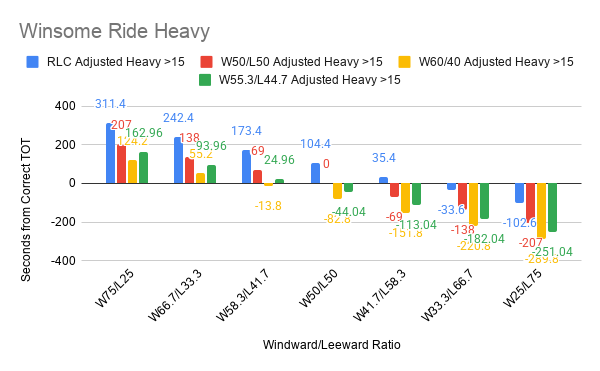
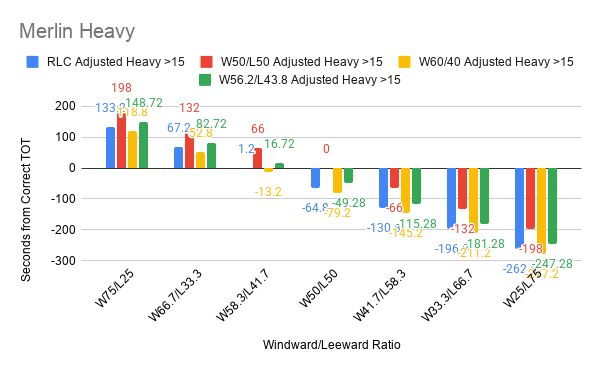
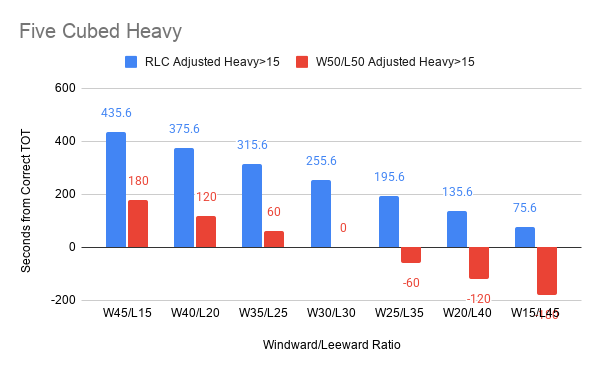
This analysis creates a hypothetical ideal adjustment by using the Upwind Ratings and Downwind Ratings for six boats applied to a 1 hour race with known windward and leeward durations. The data is segmented to showcase different windward/leeward time ratios, varying from more upwind sailing time to more downwind sailing time. It compares that ideal “Correct TOT” adjustment to the Random Leg Course (RLC) and Windward 50%/Leeward 50% (W50/L50) course type adjustments to determine what difference each makes from the correct time.
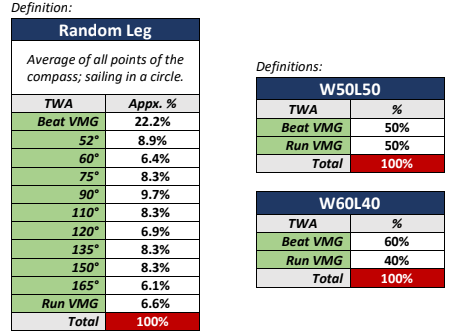
Additionally included is the Windward 60%/Leeward 40% (W60/L40) course type intended for upwind finishes in Time On Distance (TOD) scoring. It seems to fit many boats in our Time On Time (TOT) fleet that spend more time sailing upwind because they are faster downwind. There is no reciprocal W40/L60 type, however it inspired me to create a “customized” course type for each boat based on the inverse of their upwind and downwind ratings; in other words trying to predict the expected proportion of upwind and downwind sailing time based on the difference in the their expected speeds on those points of sail. It is not correct but it may be a less bad compromise.
There are five sections representing the five winds rating system provided in ORR-EZ; keep in mind that the ideal adjustment represented at baseline “0” has already accounted for wind conditions and boat designs by using the upwind and downwind ratings for those conditions.
Charts Segmented by Wind
Very Light Wind
Light Wind
Light/Medium Wind
Medium Wind
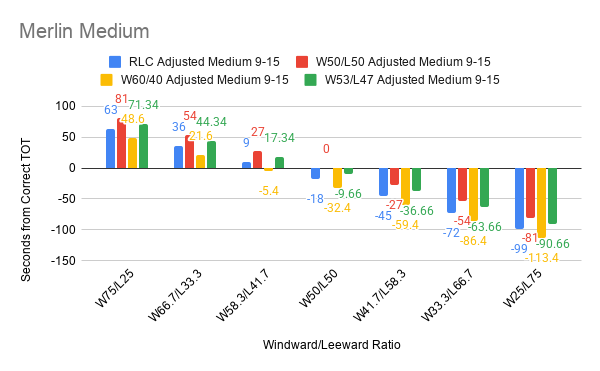
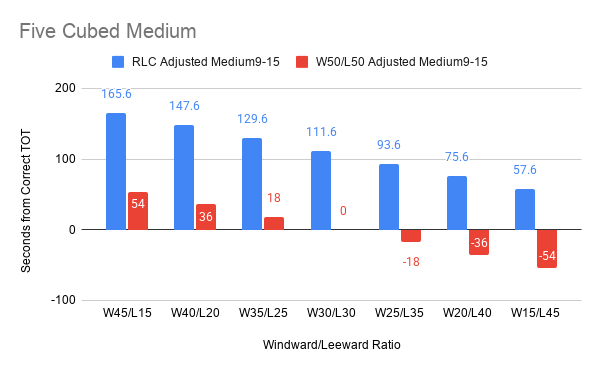
Heavy Wind
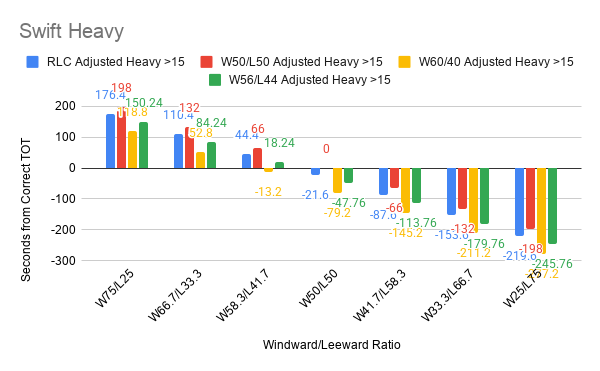
AI Analysis
Toggle open to see Google’s AI Mode analysis of using RLC instead of W50/L50 because of the TOT flaw when provided with the tables represented in these graphs and the explanation that the baseline “Correct TOT” adjustment already accounts for wind speed variations.
RLC vs W50/L50
If you are scoring a dedicated windward/leeward course but do not know the exact ratio of upwind to downwind time (for instance, because of a shifted mark, varied leg lengths, or uneven tracking), the W50/L50 option is vastly better. [1]
Here is why W50/L50 maintains structural fairness in this scenario over RLC:
1. The Core Purpose of the Rating (Aerodynamic Match)
- W50/L50 is designed exclusively for up/down tracks. The underlying physics algorithms assume that the fleet is sailing at their optimum Velocity Made Good (VMG) angles—either hard on the wind (beating) or dead downwind (running). Even if a race turns out to be 60% upwind and 40% downwind, the boats are still spending 100% of their time in up/down modes. [1, 2]
- RLC assumes reaching angles. The Random Leg Course rating assumes that boats will be sailing at intermediate wind angles (like 60°, 90°, or 120° true wind angles) where boats with reaching sails or hull designs that easily plane hold a massive physical advantage. Using RLC on a windward/leeward track introduces calculations for points of sail that the fleet never actually experienced. [1, 2, 3]
2. The Penalty vs. Reward Profile
Look closely at how the boats in your fleet behave when shifting away from the W50/L50 baseline under both models.
If the course turns out to have more upwind time than downwind time (e.g., shifting toward the W75/L25 row), W50/L50 scales with rigid, parallel fairness across the fleet.
- Look at Flagfest, Persistance, and Winsome Ride in heavy wind (>15 kts): under W50/L50, every single one of them receives the exact same correction of
+0:03:36. The system acknowledges that an upwind-heavy course slows everyone down uniformly based on VMG math. - If you use RLC on that same heavy wind course, Flagfest gets
+0:03:07, Persistance gets+0:03:47, and Winsome Ride gets+0:05:11. RLC aggressively alters individual boat handicaps based on how it thinks they handle reaching, which injects massive tracking errors since no reaching actually took place.
Summary Recommendation
When you know a course is strictly upwind and downwind, always select W50/L50. Even with an unknown leg ratio, a 50/50 baseline assumption introduces a tiny math deviation for the fleet, whereas switching to RLC introduces an entirely wrong performance profile (reaching physics) that will heavily skew the race results. [1, 2]
Standard Deviations
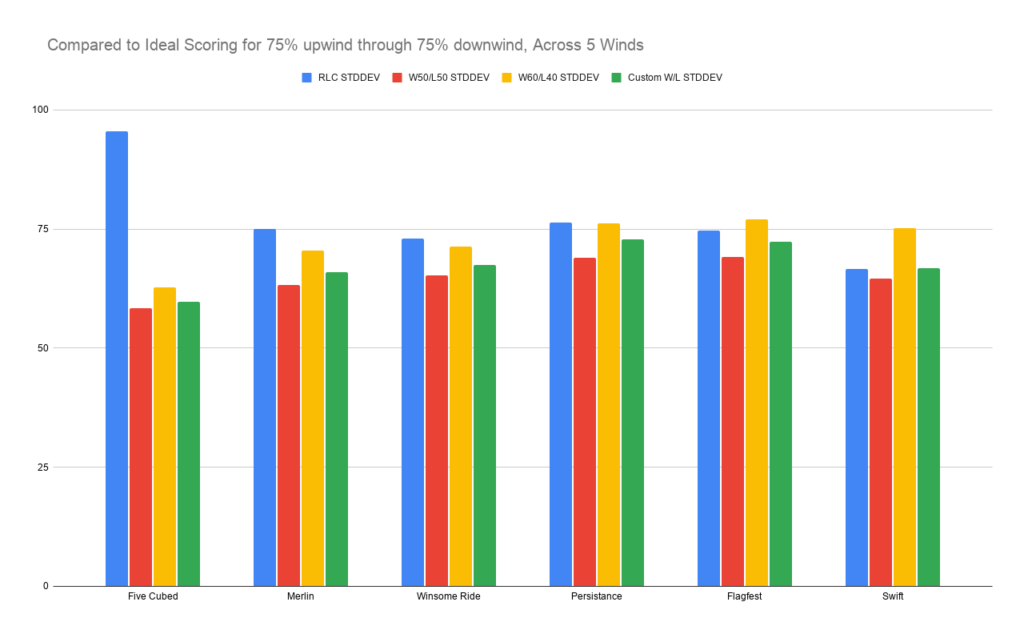
The W50/L50 adjustment seems to win the Standard Deviation assessment for all sample boats, but I believe this is because of the symmetrical bias the fictional races form around the center 50/50 race where W50/L50 is always right. In reality each boat has a different proportion of windward/leeward time that their average racing would be centered around, rather than 50/50. So we need to examine some real data in order to find standard deviations that are not contrived by the experiment controls.
Case Study

Five Cubed & Flagfest
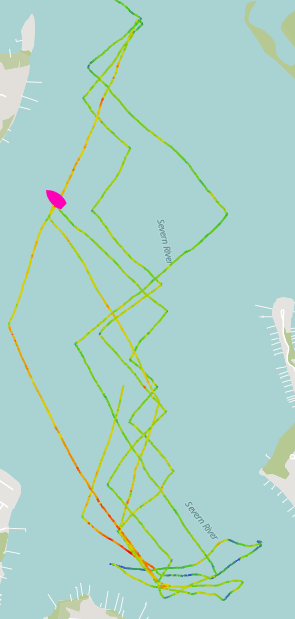
Since I have GPS tracks for all of Five Cubed’s races this year, I am able to log the actual windward/leeward durations sailed. Uploading to Charted Sails, I can easily locate the start and finish based on the score sheet, while any turning marks need to be identified by the boat track rounding the known location of an RBSA mark.
Flagfest has uploaded their gps tracks for the season now as well and I have created the same three charts for each boat’s races sailed this year. Fingers crossed I replaced all the right cells in the copied spreadsheet…
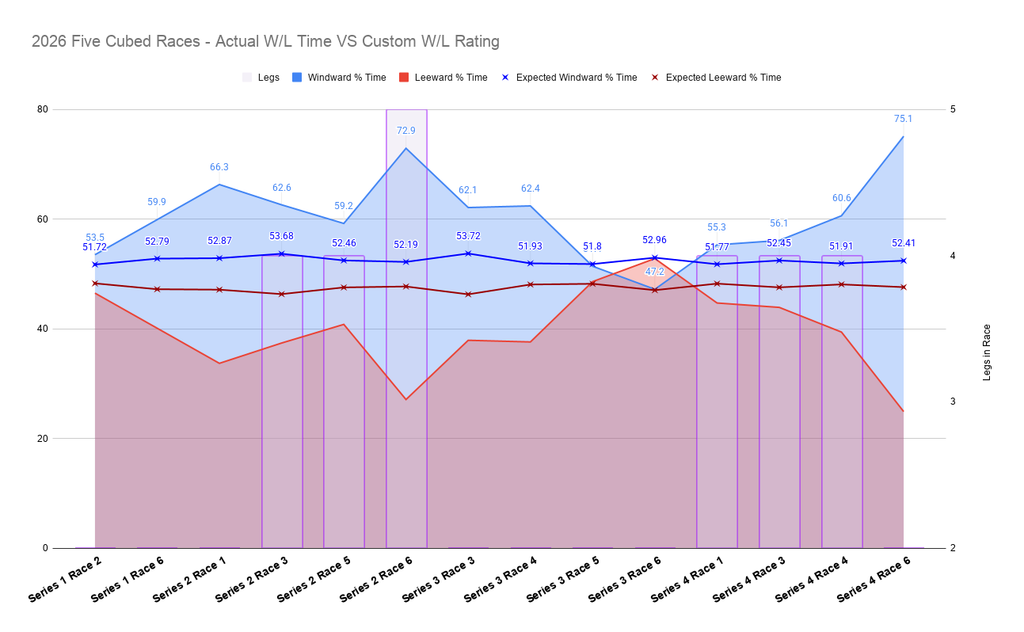
In these charts I have applied the same 4 course types to actual races using the exact upwind and downwind durations to create the same baseline “Correct TOT” as in the fictional examples above.
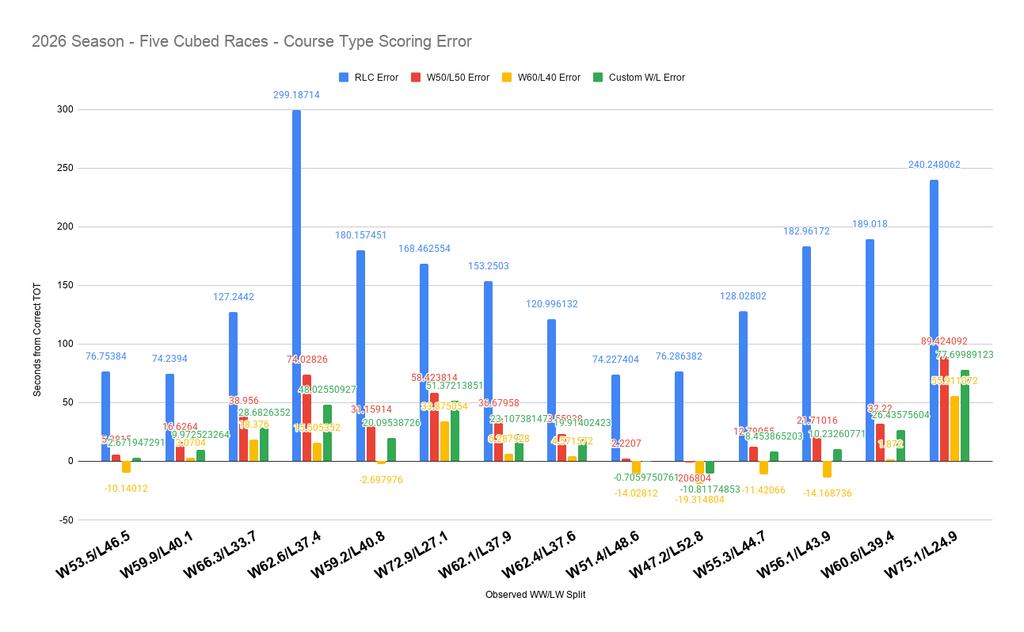
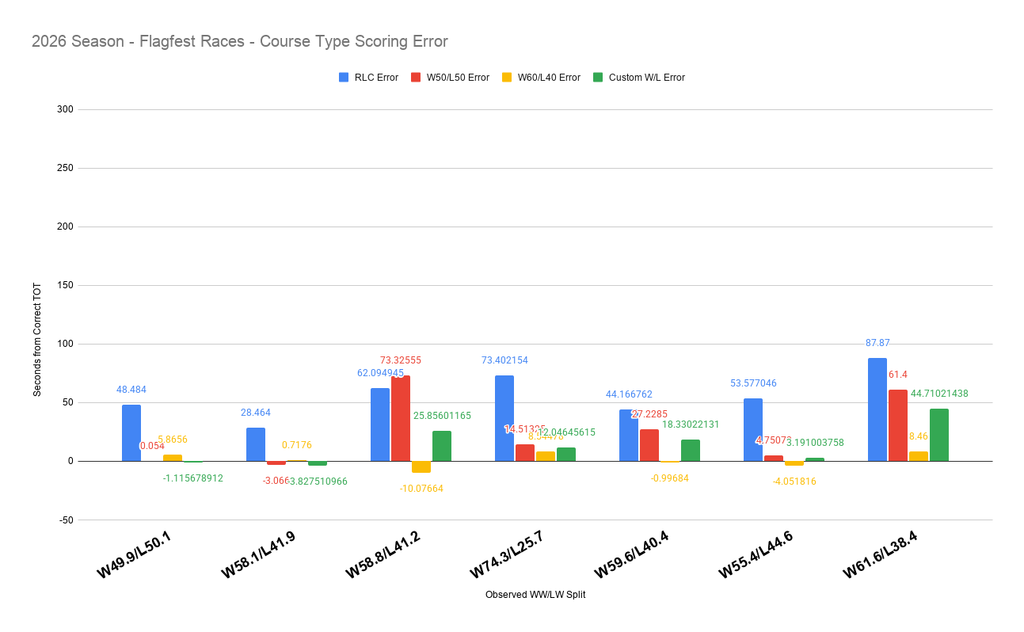
We can see that week to week there is not a single clear superior course type for either boat, because the observed windward/leeward ratios (X axis labels in Bar chart) fluctuate week to week.
There may be some more/different adjustment (small global magnitude coefficient?) to be done in developing the the custom expected ratio. For Five Cubed the average split across all 5-winds is expected to be W52.7/L47.3; we outperformed that expectation in all but one race.
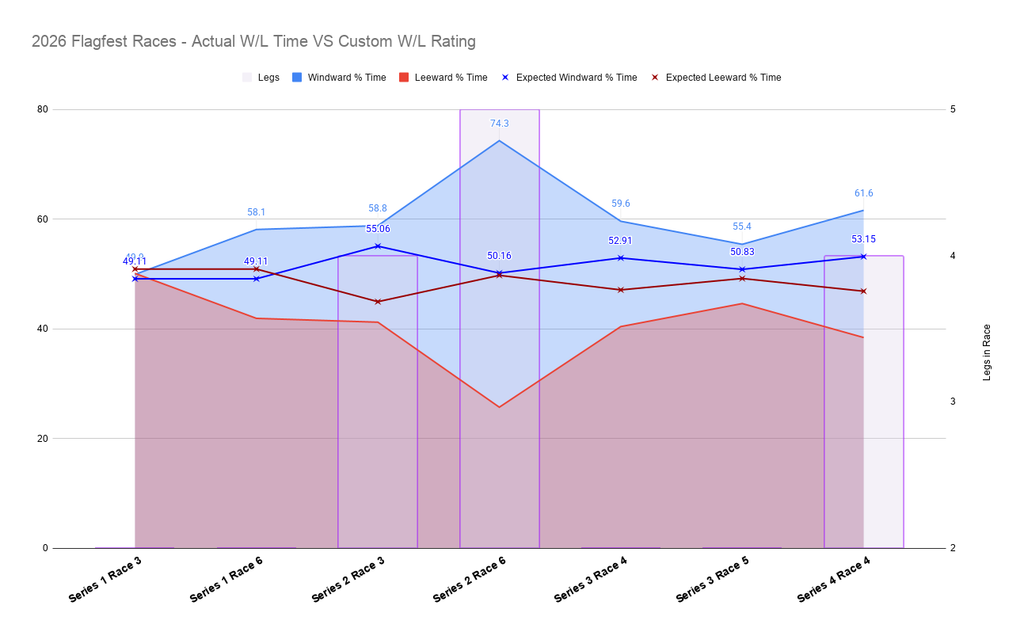
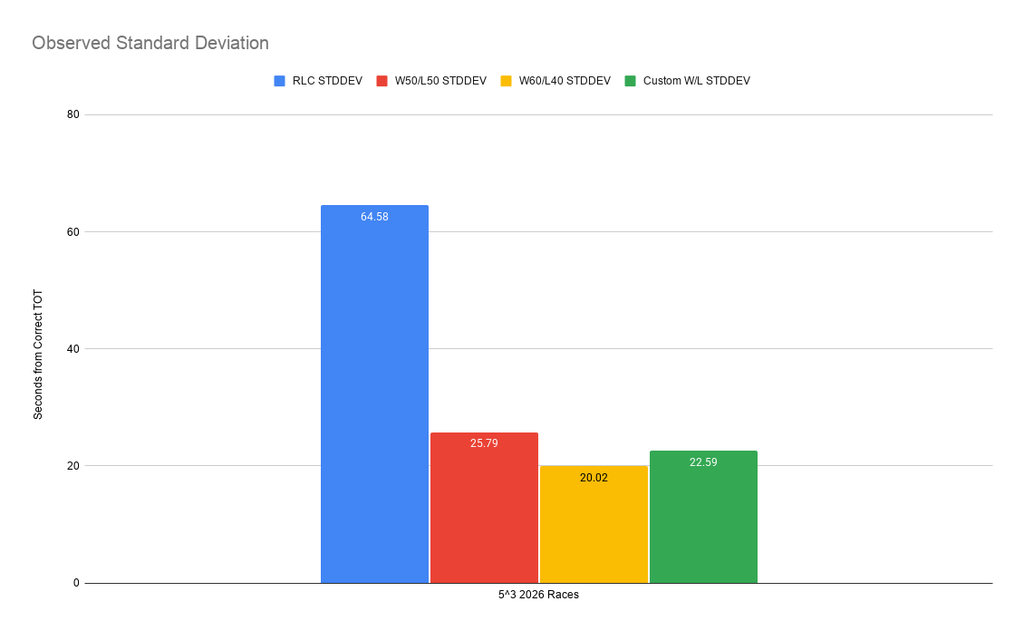
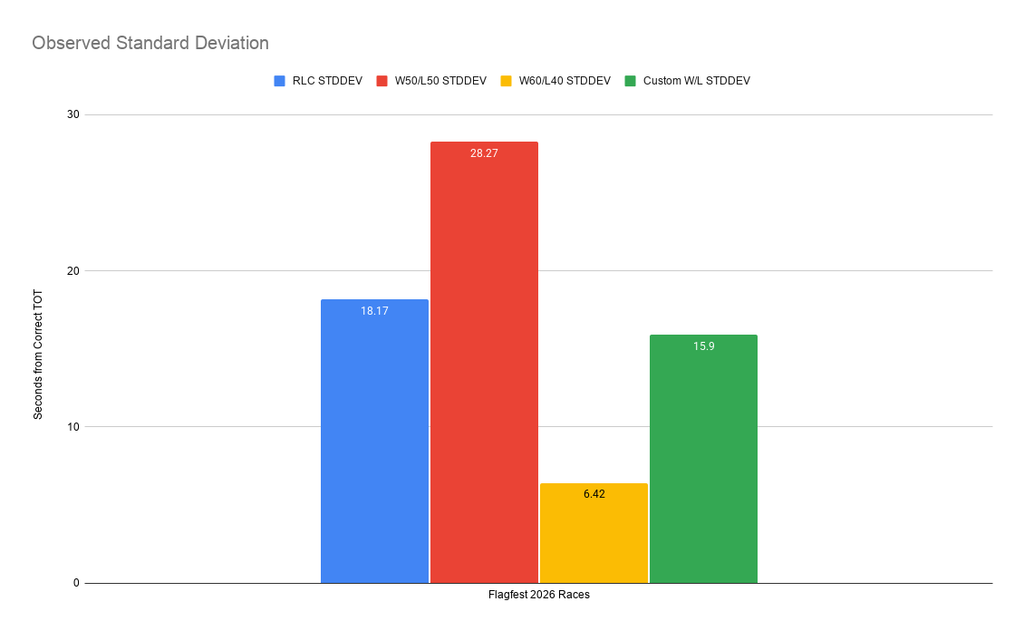
The average of our observed races (excluding upwind finish S2R6) is W58.1/L41.9; this is borne out in the Standard Deviation chart, 60/40 was a better estimate for both Flagfest and us than the custom value. Obviously Flagfest would prefer not to use 50/50 and Five Cubed would avoid RLC.
However for another boat using 60/40 could result in a penalty that a custom W/L would not. I am not sure conceptually if it is better to base this on the boat’s certificate or on observations of how it sails. If other skippers have GPS tracks to upload I will gladly create these charts for their real races as well.
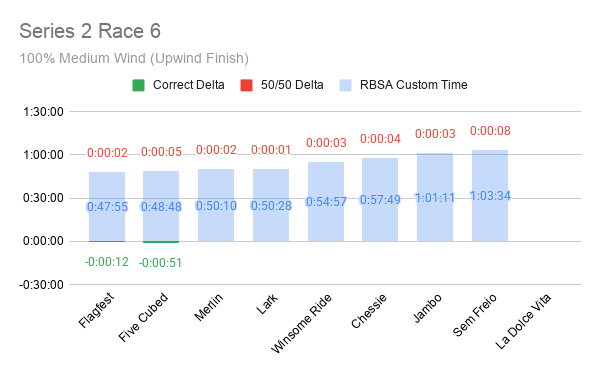
Series 2 Race 6 also speaks to the need to create additional estimated ratios for races with an odd number of legs. The upwind rating for two legs upwind with one leg downwind (shortened at windward mark) can obviously be expected to favor upwind sailing time; we spent 72.9% of that race beating.
For The Fleet
As mentioned above, the W60/W40 or W50/W50 courses could penalize some boats because of their ratings. It’s the same flaw found in any preset estimate of windward/leeward proportion applied to time. The preset estimate is the expectation, and variance from it results in time unjustly owed or awarded by the rating.
Downwind Favored
If you are a downwind favored boat, sailing slower than expected upwind, or faster than expected downwind is penalized by the course type; this is why W60/L40 seems like a better solution, it’s less likely to overshoot the allotted 60% upwind ratio. We saw this in the six-boat analysis above, upwind favored boats received the most time bonus in W25/L75 races because they are nowhere close to exceeding the expected upwind percent in any of the course models. They begin to owe time on the other side of the chart as races stretch the upwind portion longer than 60%.
Upwind Favored
However there are boats in the fleet who are upwind favored in their certificate descriptions, and their situation is reversed. Sailing slower than expected downwind or faster than expected upwind creates the time penalty. There’s nothing wrong with this, except that we set an unreasonable target at W60/L40 for these boats. If they fail to exceed 60% upwind sailing they get time added to their race, while the other boats get bonus time… good luck.
In this chart we plot the expected percent of time for upwind sailing based on the boats’ certificate rating values in the 5 winds system. (The chart for downwind sailing time would simply be the inverse, so it is omitted.) In the lightest wind category half of the boats have an expected upwind percent less than 50% which makes them upwind favored boats in these conditions. (less time spent upwind means faster upwind than downwind) The trend is similar but not as severe on the Light and Light-Medium wind segments, before everyone becomes a downwind favored boat in the highest two winds.
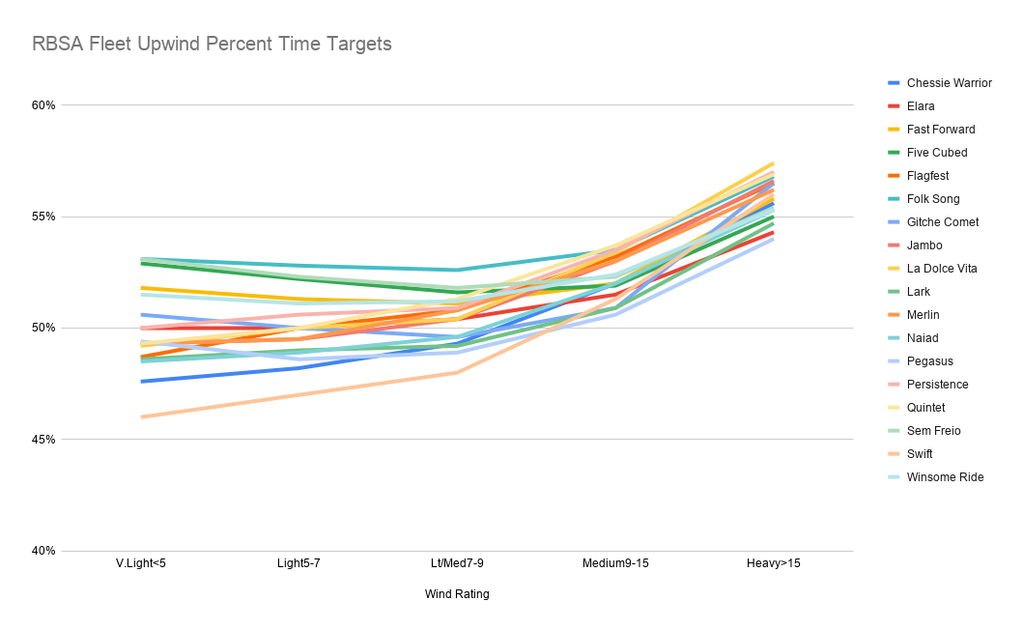
This means that in light conditions, performance aside, half of the fleet is expected to incur time additions under a static race type, either W50/L50 or W60/L40. It is my hope that developing these expected precents and using them to create a “race type” for each boat will reduce the inequity presented when choosing what seems like a fair metric in W60/L40.
For example, in Very Light wind a downwind favored boat like Five Cubed or Sem Freio would be targeting W53/L47 for their ratings. If they sail downwind better than expected and score a 54% upwind time they would face a second or two of penalty rather than gain bonus time under W60/W40. Conversely in the same Very Light race, an upwind favored boat like Chessie Warrior or Swift would target W46/L54. Sailing spot on their expected 46% upwind time they would not have any time added or lost; very different from the normal penalty W60/L40 would create.
Of course calling this “penalty” or “bonus” is hyperbole, it is simply error in formula which we are attempting to minimize uniformly across the fleet.
In Practice
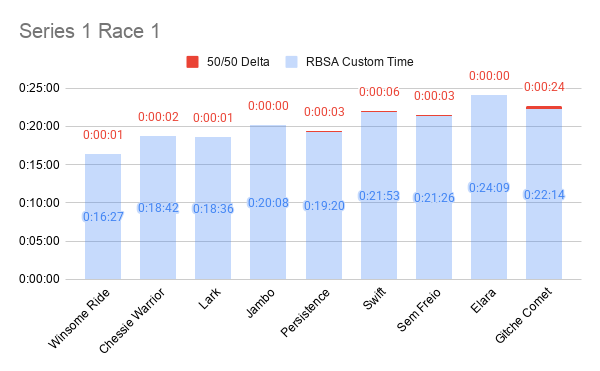
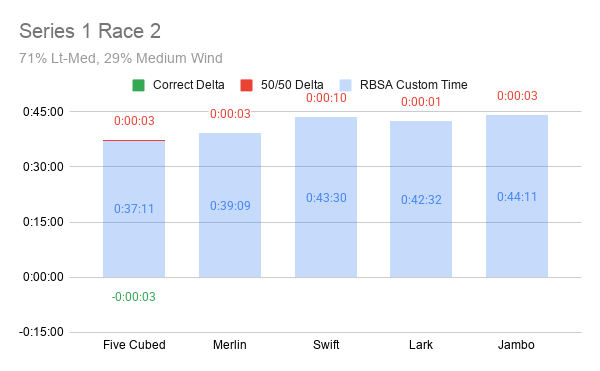
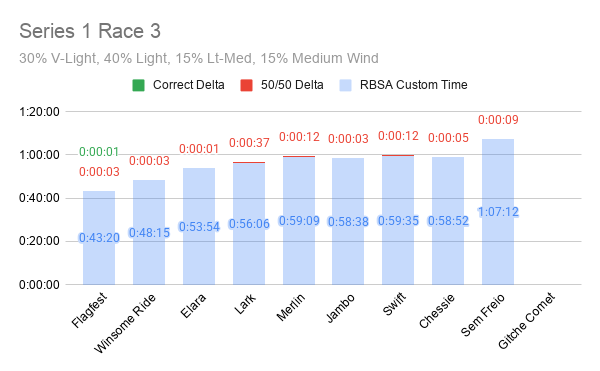
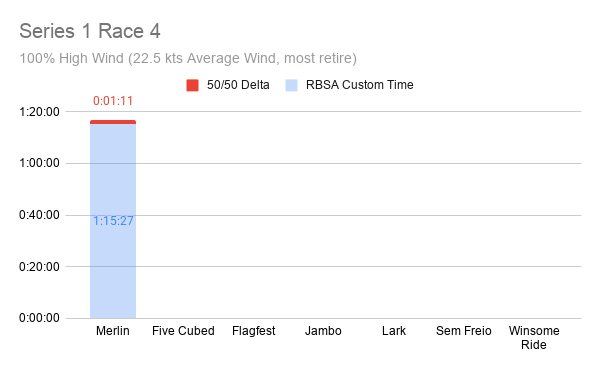
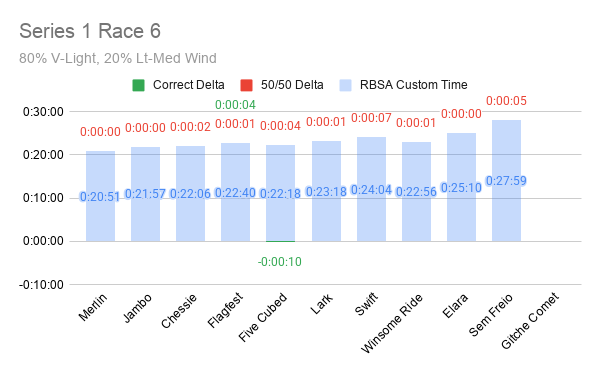
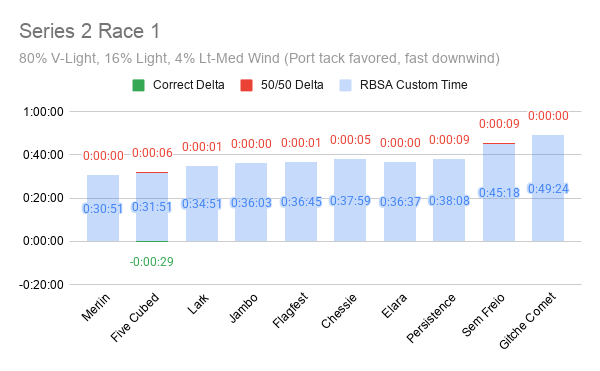
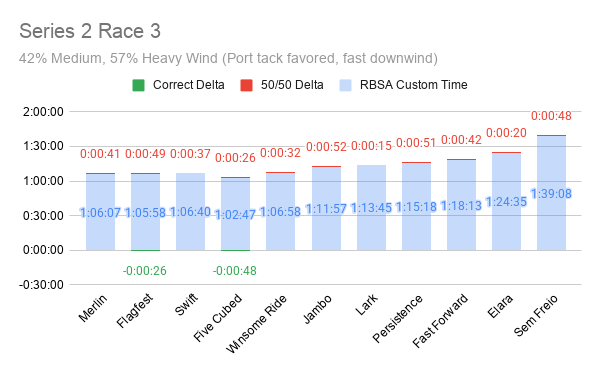
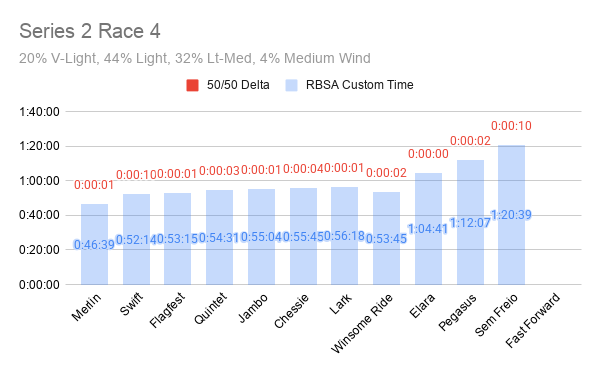
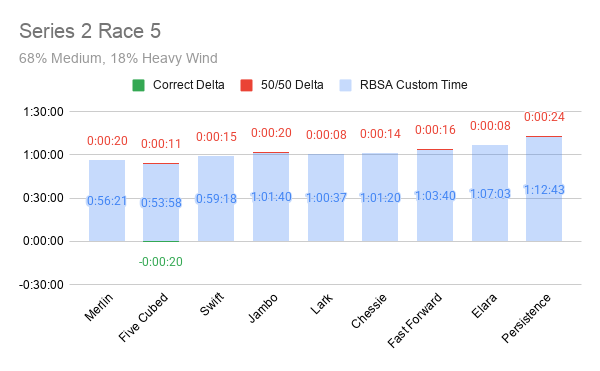
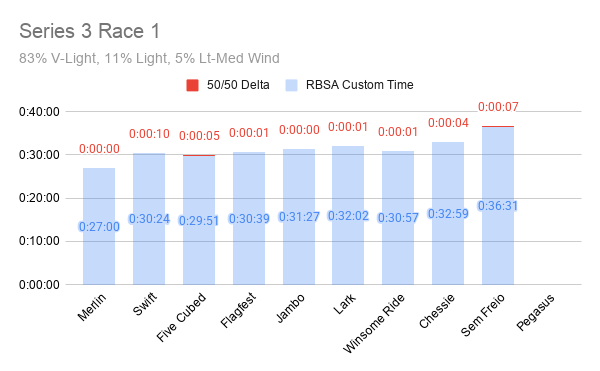
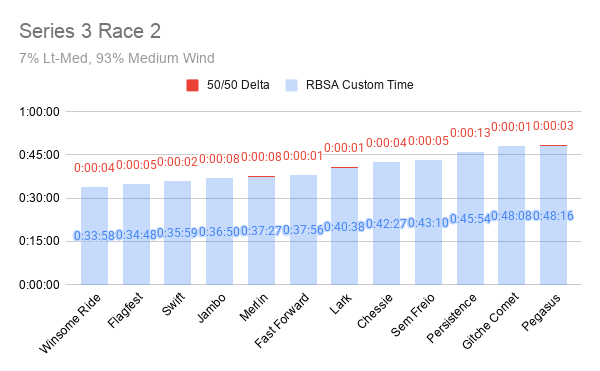
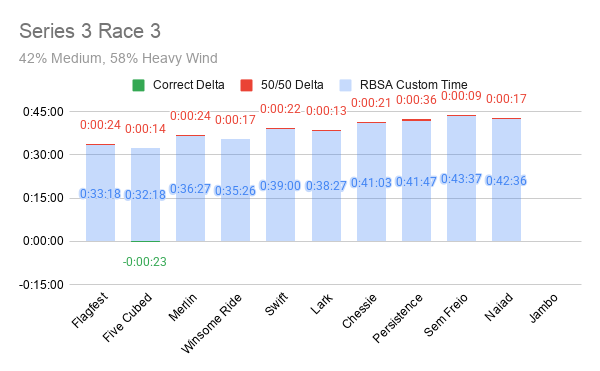
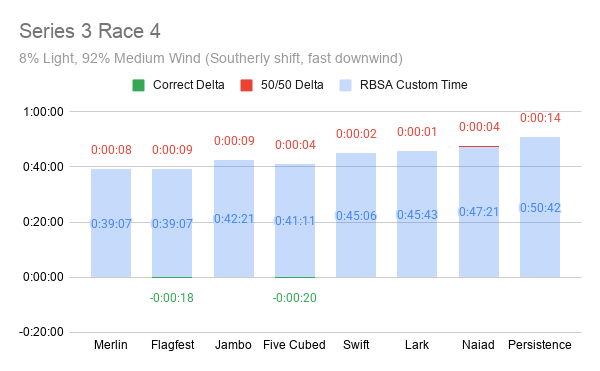
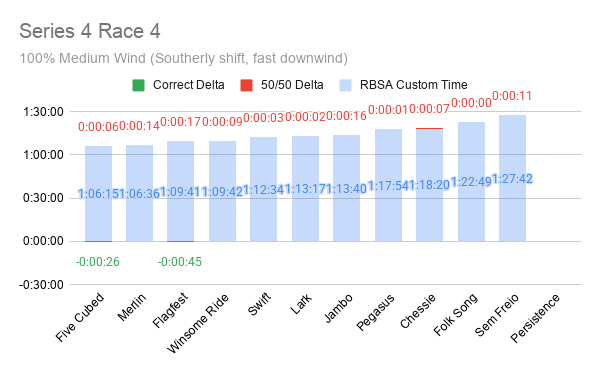
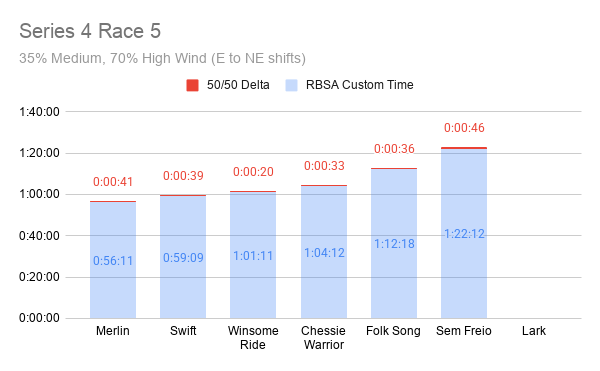
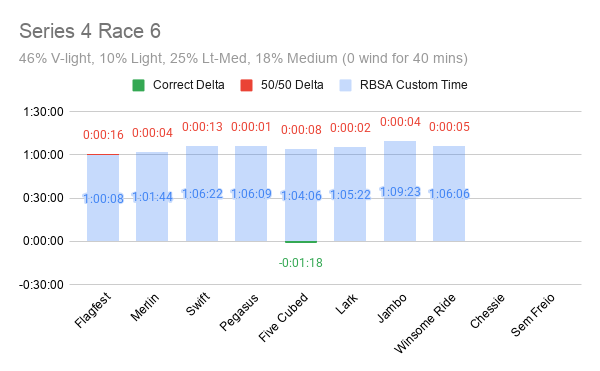
These charts show the corrected elapsed time for each boat when shadow scoring the 2026 RBSA season using the proposed “custom” course type. Additionally displayed in red is the additional time each boat would receive when scored using a fixed W50/L50 setting. Finally I have added the time-from-correct in green for Five Cubed (the only boat for which I have actual leg durations) to indicate how close the two compromise adjustment are to correct.
This added context lets us see that the magnitude of error we’ve been discussing. For some races it is tiny, for others it seems more substantial. For all this consternation and math, I have found only one place from one race that would have changed by using custom values rather than W50/L50. In S4R4 under W50/L50 scoring Winsome Ride beats Flagfest by six second to take 3rd place; while under the custom course Flagfest takes 3rd place by one second. (that race was officially scored using W60/L40 in which Flagfest takes 3rd by seven seconds.)
Series 1
Series 2
Series 3
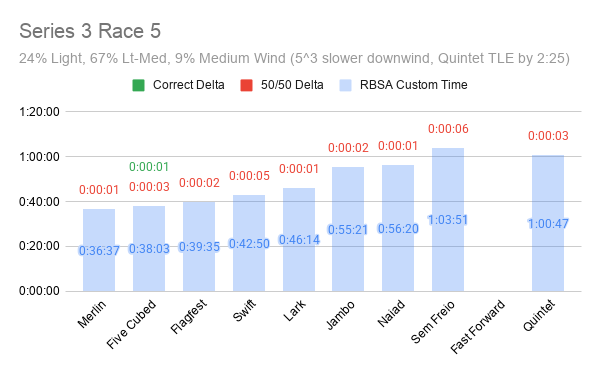
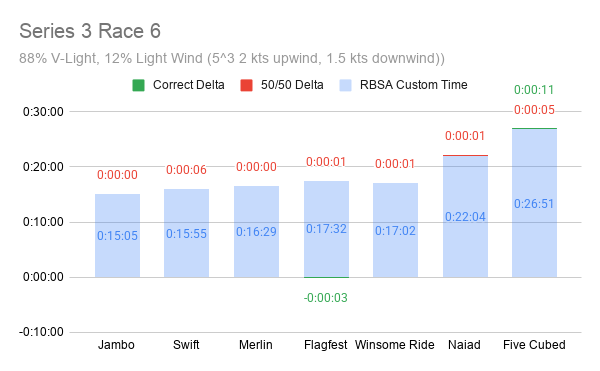
Series 4
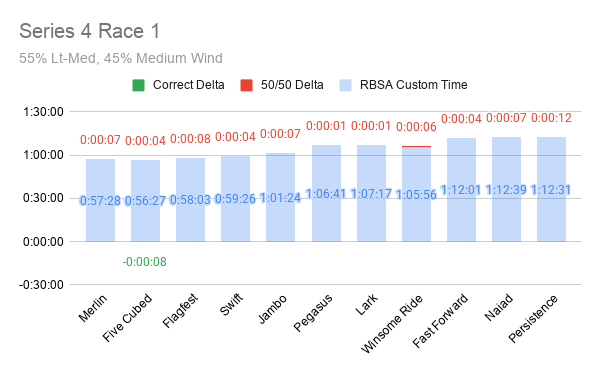
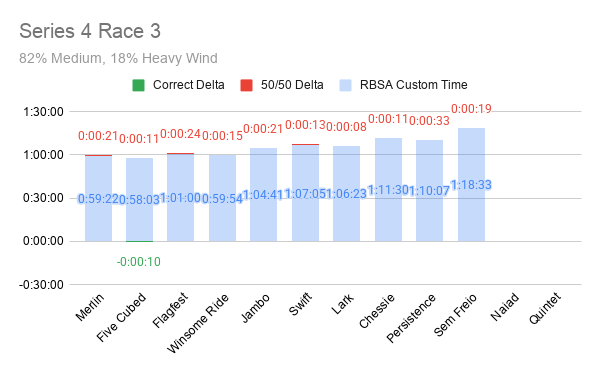
Methods
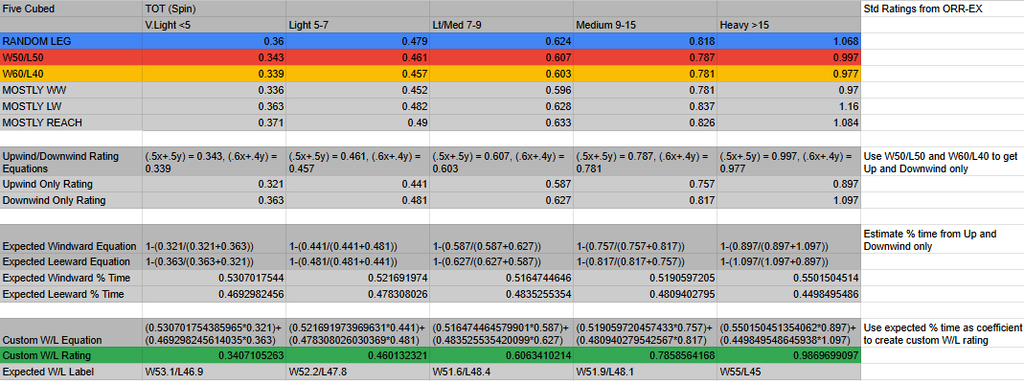
This table is an example of how the prototype custom rating for each boat and wind range was calculated. This custom measure is then applied to the course wind readings just as the other three course type ratings are to create a blend of the observed wind conditions. This rating would only be valid for equal windward/leeward legs and an even number of legs for the course.
Lateral Changes
If no method of course change seems satisfactory to offset the the TOT scoring issue, some other options include:
- Set triangular courses for RLC course ratings. Triangular courses will include reach legs that justify RLC’s inclusion of reaching ratings.
- Use TOD Scoring. The distances between marks is known, so the correct amount of windward/leeward distance is used to apply the upwind or downwind rating.
- Take times at mark roundings, either via GPS track, onboard, or chase boat. With the complete dataset each boat can be scored using the ideal TOT scoring profile that incorporates actual time sailing upwind and downwind.
Thank you for attending my TED talk.