
RLC vs W50/L50
We examine the effect of applying different ORR-EZ course types to a windward leeward course to account for the flaw in adjustment when using TOT scoring with unknown durations of upwind and downwind sailing.
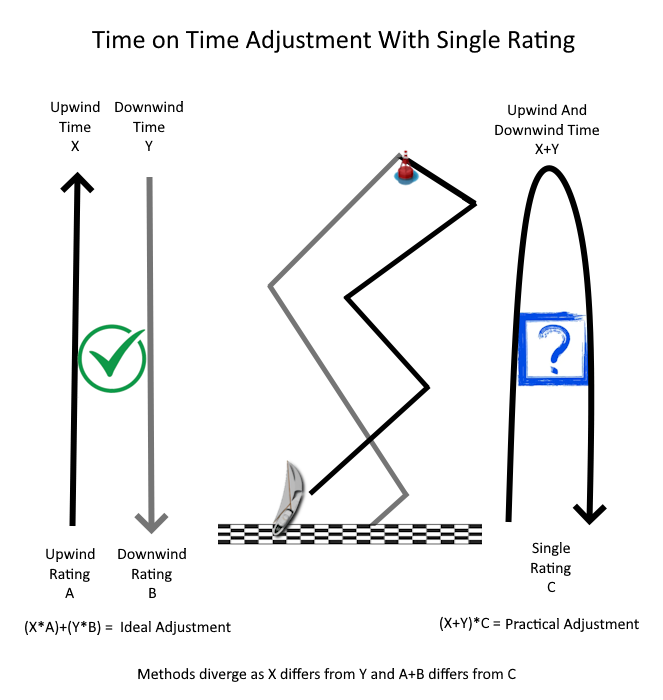
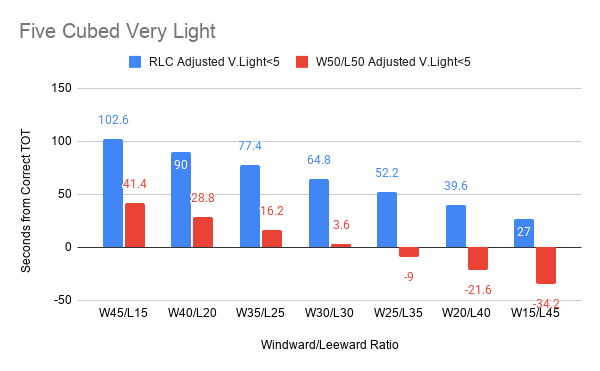
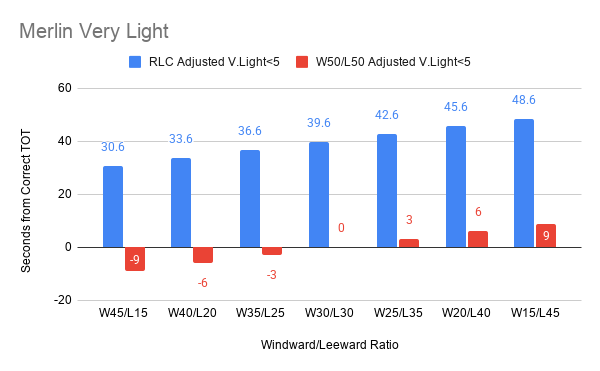
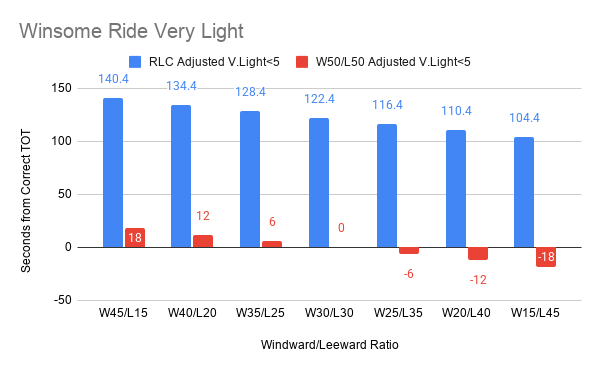
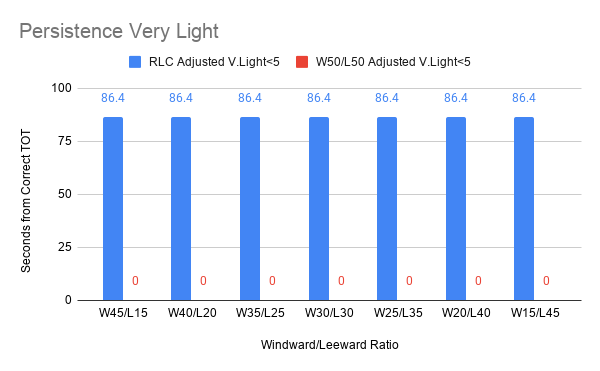
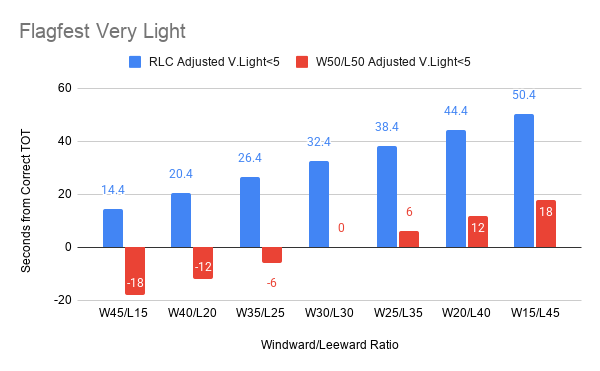
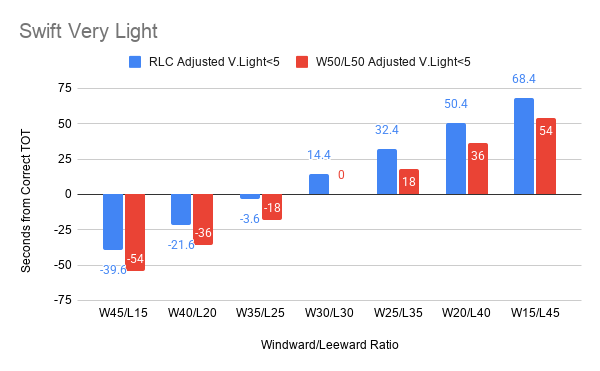
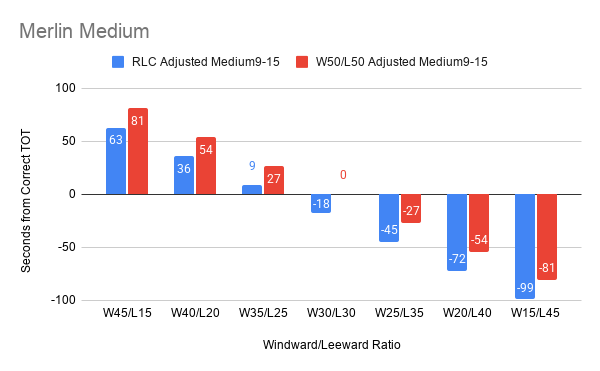
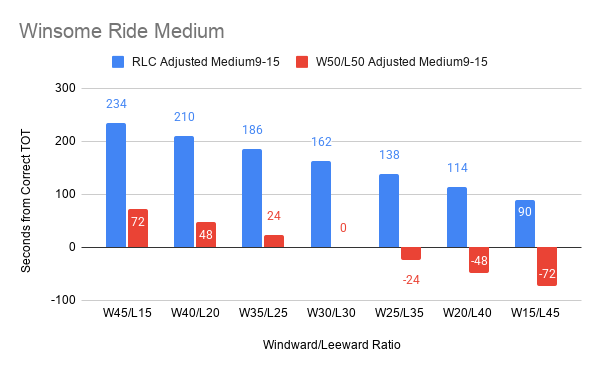
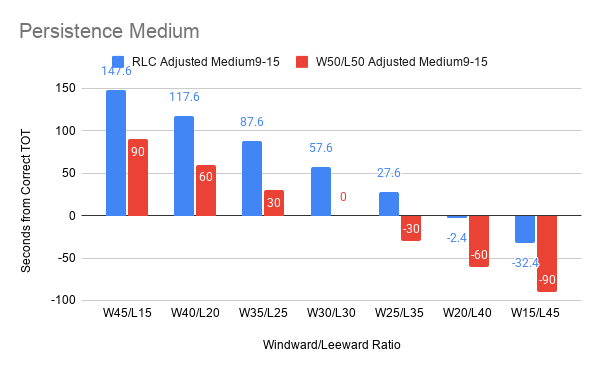
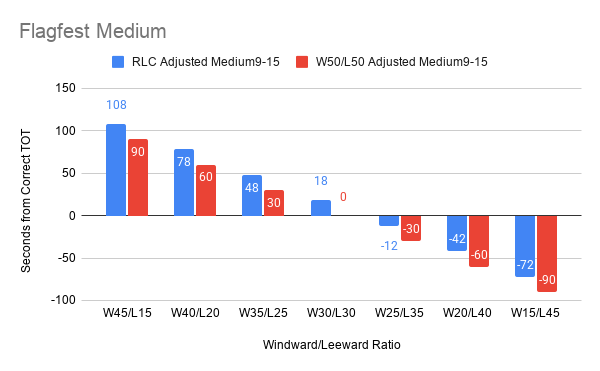
This analysis takes creates a hypothetical ideal adjustment by taking Upwind and Downwind ratings for six boats applied to a 1 hour race. The data is segmented to showcase different time ratios, varying from more upwind sailing time to more downwind sailing time. It compares that ideal “Correct TOT” adjustment to the Random Leg Course (RLC) and Windward 50% Leeward 50% (W50/L50) course type adjustments to determine what difference each makes from the correct time. There are five sections representing the five winds rating system provided in ORR-EZ; keep in mind that the ideal adjustment represented at baseline “0” has already accounted for wind conditions by using the upwind and downwind ratings for those conditions.
Very Light Wind
Light Wind
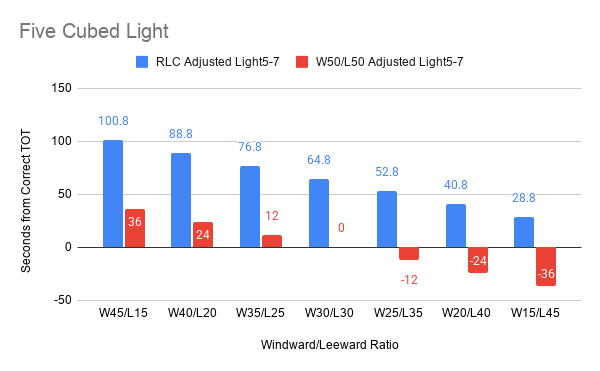
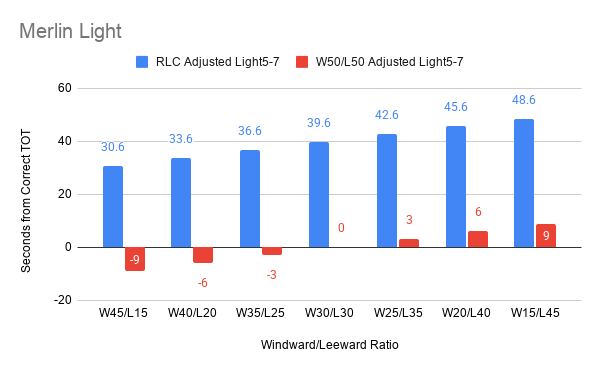
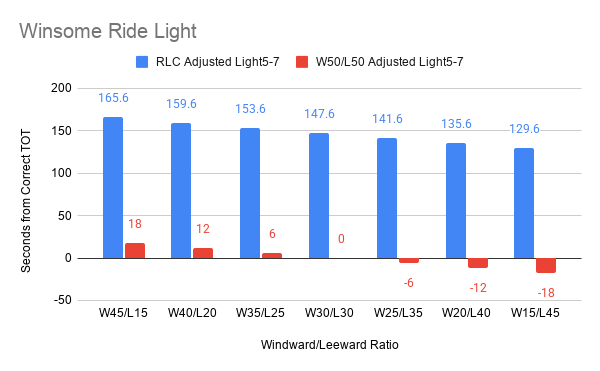
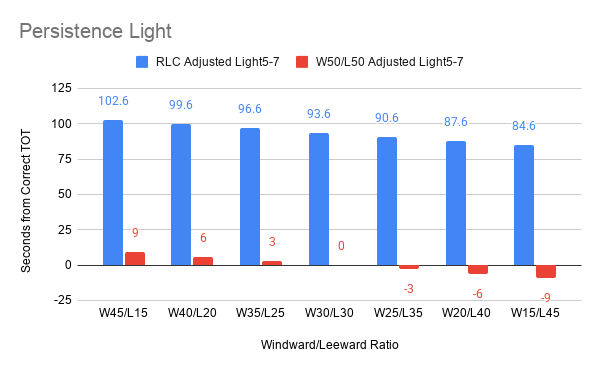
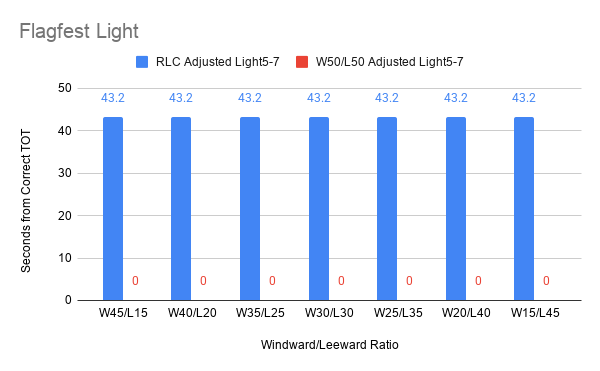
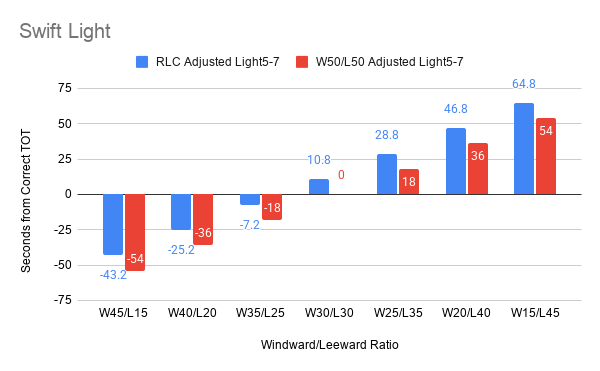
Light/Medium Wind
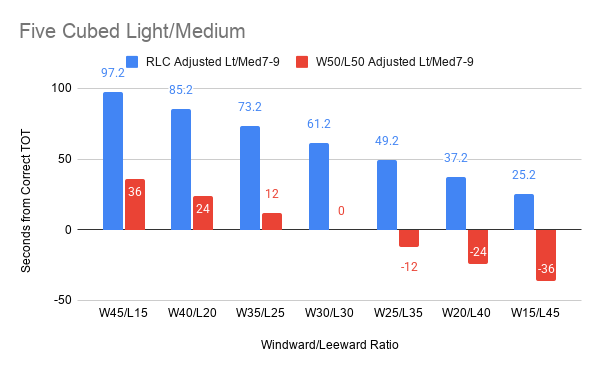
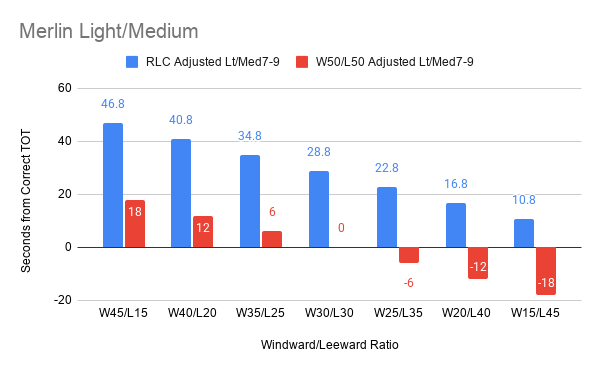
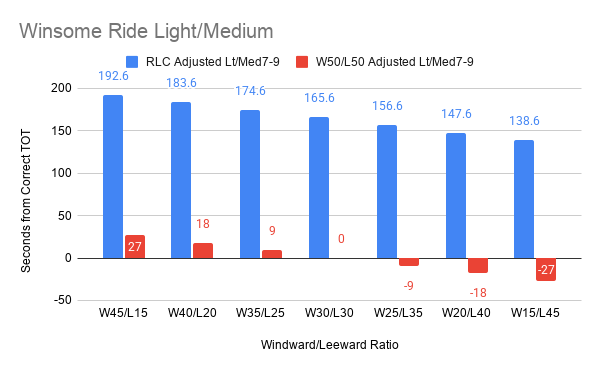
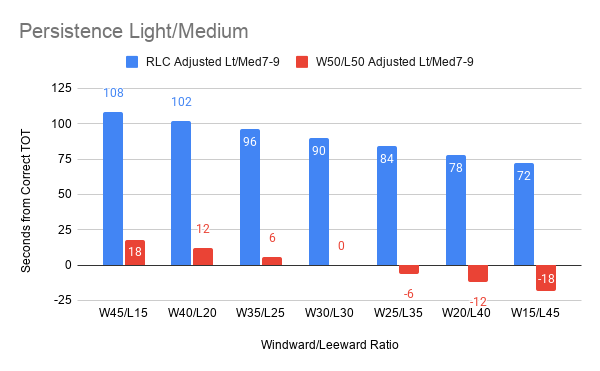
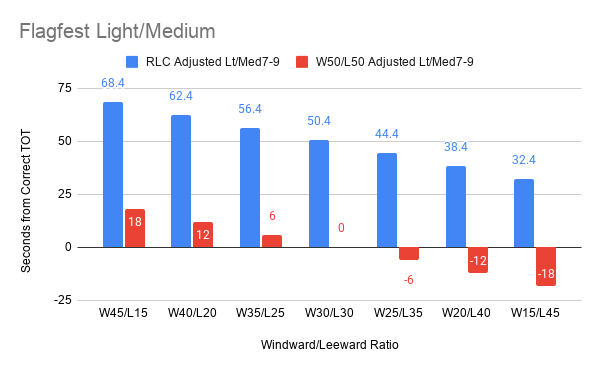
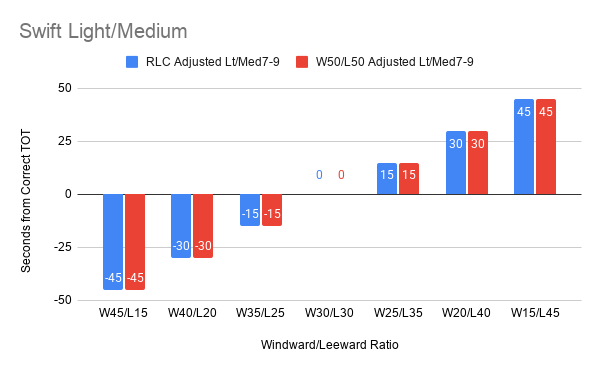
Medium Wind
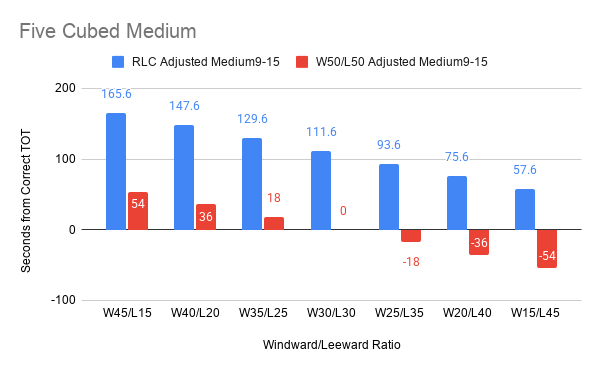
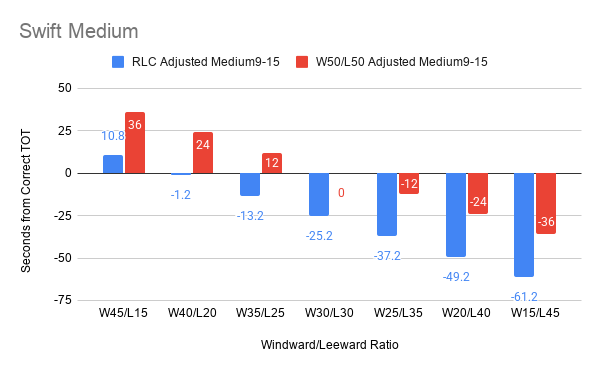
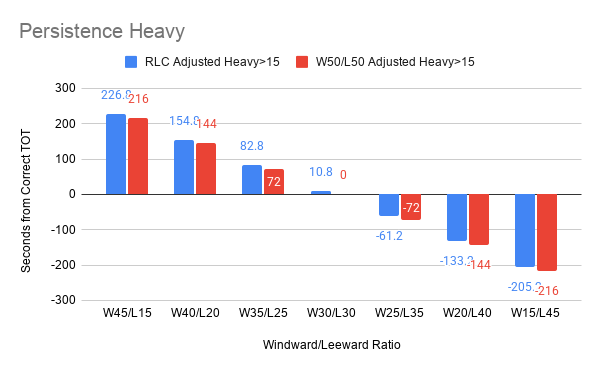
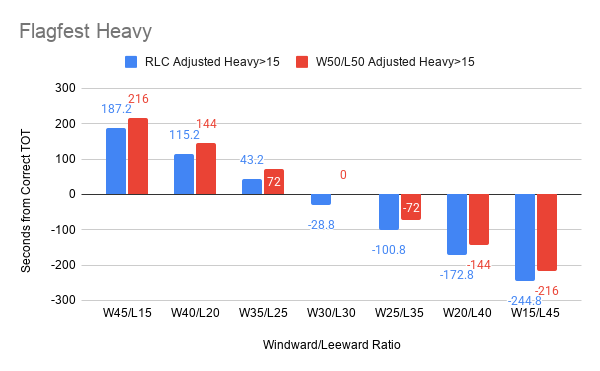
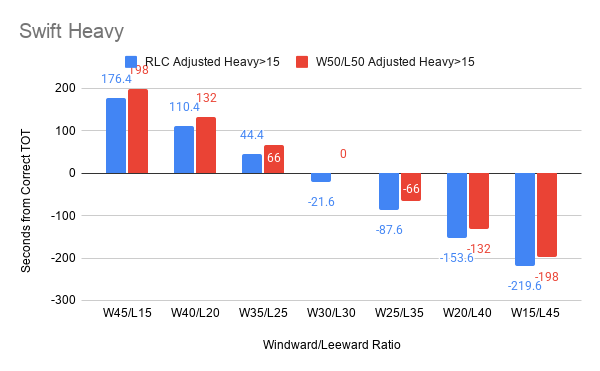
Heavy Wind
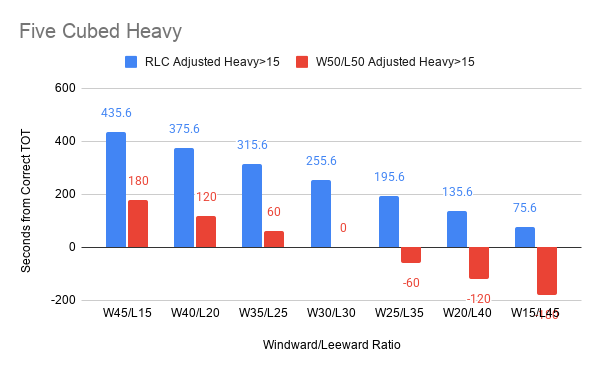
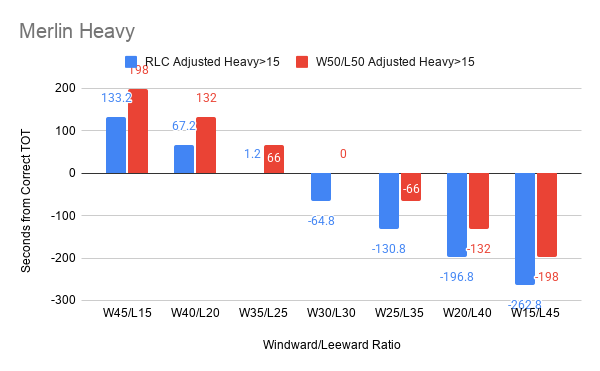
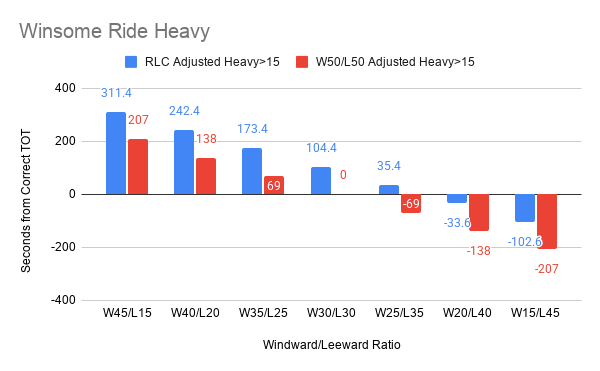
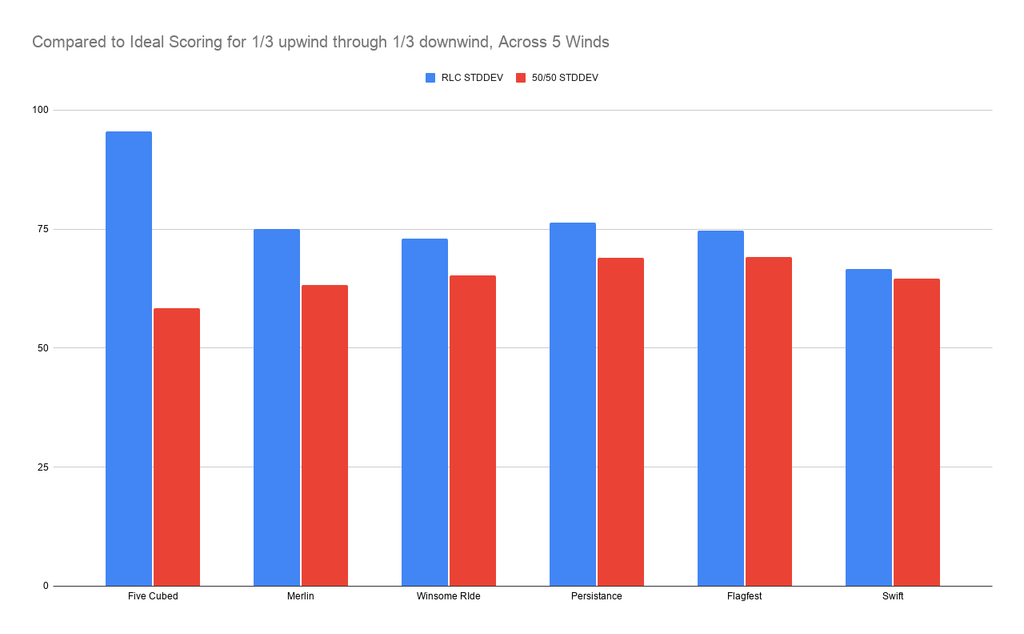
Standard Deviations
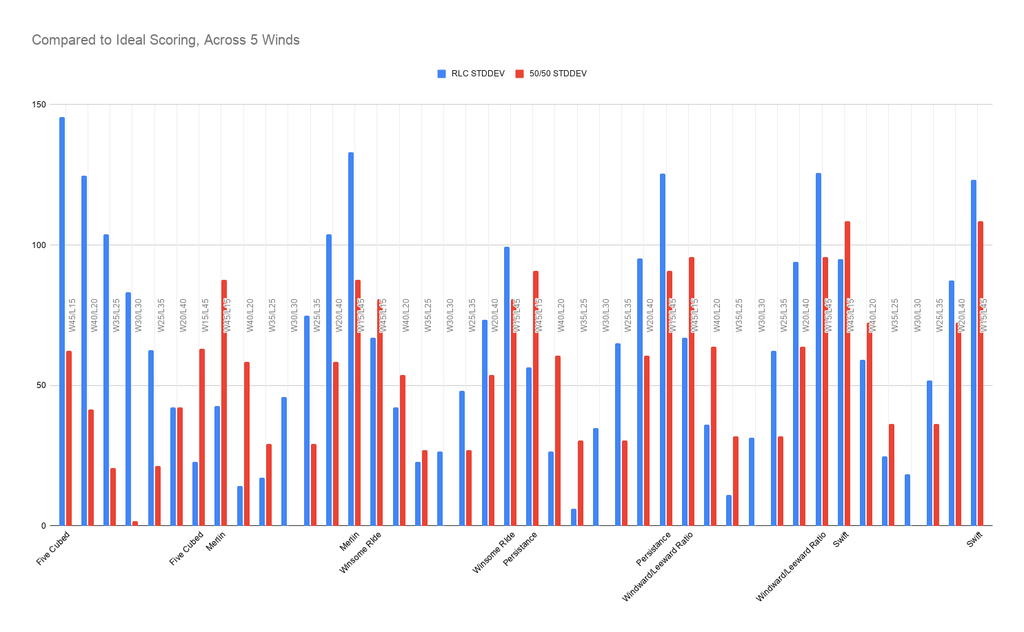
AI Analysis
Provided with the tables represented in the graphs and the explanation that the baseline “Correct TOT” adjustment already accounts for wind speed variations, this is Google’s AI Mode analysis:
If you are scoring a dedicated windward/leeward course but do not know the exact ratio of upwind to downwind time (for instance, because of a shifted mark, varied leg lengths, or uneven tracking), the W50/L50 option is vastly better. [1]
Here is why W50/L50 maintains structural fairness in this scenario over RLC:
1. The Core Purpose of the Rating (Aerodynamic Match)
- W50/L50 is designed exclusively for up/down tracks. The underlying physics algorithms assume that the fleet is sailing at their optimum Velocity Made Good (VMG) angles—either hard on the wind (beating) or dead downwind (running). Even if a race turns out to be 60% upwind and 40% downwind, the boats are still spending 100% of their time in up/down modes. [1, 2]
- RLC assumes reaching angles. The Random Leg Course rating assumes that boats will be sailing at intermediate wind angles (like 60°, 90°, or 120° true wind angles) where boats with reaching sails or hull designs that easily plane hold a massive physical advantage. Using RLC on a windward/leeward track introduces calculations for points of sail that the fleet never actually experienced. [1, 2, 3]
2. The Penalty vs. Reward Profile
Look closely at how the boats in your fleet behave when shifting away from the W30/L30 baseline under both models.
If the course turns out to have more upwind time than downwind time (e.g., shifting toward the W45/L15 row), W50/L50 scales with rigid, parallel fairness across the fleet.
- Look at Flagfest, Persistance, and Winsome Ride in heavy wind (>15 kts): under W50/L50, every single one of them receives the exact same correction of
+0:03:36. The system acknowledges that an upwind-heavy course slows everyone down uniformly based on VMG math. - If you use RLC on that same heavy wind course, Flagfest gets
+0:03:07, Persistance gets+0:03:47, and Winsome Ride gets+0:05:11. RLC aggressively alters individual boat handicaps based on how it thinks they handle reaching, which injects massive tracking errors since no reaching actually took place.
Summary Recommendation
When you know a course is strictly upwind and downwind, always select W50/L50. Even with an unknown leg ratio, a 50/50 baseline assumption introduces a tiny math deviation for the fleet, whereas switching to RLC introduces an entirely wrong performance profile (reaching physics) that will heavily skew the race results. [1, 2]
Reminded again that windspeed variations are already accounted for and that this assessment is solely to address the unknown upwind and downwind sailing durations:
Given that you cannot take exact leg times during the race, W50/L50 is the only viable and fair method to use in the real world.
Since you cannot track exact durations, your scoring program must default to a predicted course layout assumption. Choosing between the two options boils down to how they handle a standard windward/leeward race.
1. The Real-World Baseline Alignment
A standard windward/leeward race is physically designed to feature an even split of upwind and downwind work. Because W50/L50 perfectly zeroes out at the W30/L30 mark, it sets a flawless baseline for your real-world races.
If you use the W50/L50 table, you can simply input the baseline wind speed zone for the day, leave the course ratio at W30/L30, and the system adds exactly 0:00:00 of secondary error into your results. It trusts the underlying upwind/downwind wind polars your system is built on.
2. The Toxic Math Error of RLC
If you force the RLC (Random Leg Course) option onto a windward/leeward race with unknown exact times, you introduce severe tracking errors.
Because RLC assumes the fleet is sailing on reaching angles (which do not exist on a clean up/down track), it builds a highly volatile wind-speed dependency right into your baseline rows. Look at the adjustments it forces at a normal W30/L30 split:
- Swift: Gets an arbitrary
22-secondcredit in heavy air, but a14-secondpenalty in light air. - Winsome Ride: Slaps a massive
2 minute and 46 secondpenalty onto the boat in medium air.
By choosing RLC, you are punishing or rewarding specific boats based on how the table thinks they sail on reaching angles, despite the fact that the fleet spent the entire day strictly beating upwind and running downwind.
Final Practical Rule
When exact times are unmeasurable but the course layout is an upwind/downwind configuration, W50/L50 acts as a clean mathematical bypass. It completely protects your carefully calculated baseline polars from being corrupted by fictional reaching physics.